Affinity Groups at Duke University Hospital System
This resource was developed as part of the CaroNova Workforce Experience Accelerator program and published on the Center’s website in partnership with CaroNova. To learn more, visit: https://caronova.org/healthcare-system-workforce-experience-accelerator/
Overview Summary:
Duke University Health System’s Affinity Group program is a comprehensive, employee-led initiative designed to foster inclusion, connection, and professional growth across the health system. These groups serve as intentional spaces where employees can build community, elevate voices, and contribute to a culture of belonging.
Program Highlights
- Strategic Alignment: Groups are integral to advancing core priorities such as talent development, retention, innovation, and a culture of belonging.
- Employee-Led Growth: Originally formed and voluntarily led by employees, empowering them to lead, innovate, and thrive.
- Surgeon General Alignment: Directly aligns with the Five Essentials for Workplace Mental Health & Well-Being, specifically Connection & Community and Mattering at Work.
Primary Recommendations
- The program is recommended for enhancing employee engagement, retention, and leadership development. It benefits clinical, administrative, and support staff by creating inclusive spaces that recognize contributions and provide professional development opportunities.
Program Description
The solution is an employee-led initiative where participants and allies from all backgrounds collaborate through Affinity Groups.
A few examples of our DUHS affinity groups are below:
- Asian American and Pacific Islander Affinity Group: envisions to affirm identities and create a safe place for discussion to cultivate community, educate, and inspire AAPI team members and allies alike.
- Duke Moms Affinity Group: strives to provide an inclusive, safe environment for team members who identify as a mother or mother-to-be (biological and otherwise) and create a culture of support and advocacy.
- Juntos Affinity Group: advocates for our Hispanic/Latine team members through career development and raising awareness of the social, economic, and wellness gaps experienced by the community. Allies are always welcome!
Core elements include:
- Governance: Groups maintain records, plan events, and engage with steering committees and executive sponsors.
- Structure: Led by co-chairs and committees with a defined meeting cadence and reporting lines.
- Activity: Programming includes networking, mentoring, and learning opportunities designed to build community and elevate employee voices.
Program Resources
- Affinity group leader resources: Accessible tools including draft bylaws, charters, and participation criteria. Guidelines for event planning, budgeting, and project management.
- Communication platform: An organizational hub (intranet/newsletter) for resources and information.
Implementation Plan and Support
Resources Needed for Getting Started
- Senior Leadership Buy-In: Necessary to unlock resources, budget, and visibility.
- Operational Oversight: A point of contact for project management and access to HR/Talent systems.
- Policy Foundation: Established policies, guidelines, and a strategic plan outlining objectives and scope.
Implementation Plan Outline
Stage 1: Planning & Preparation: Define purpose, develop a strategic plan, select metrics, and secure leadership buy-in.
Key Examples:
- Clarify purpose & alignment
Example: “An Affinity Group exists to foster community, support professional development, and strengthen retention of employees while contributing to Duke Health’s culture of belonging.” - Outline objectives, scope, and governance
Example:- Objective: Host 4+ programs annually focused on community, development, and cultural awareness
- Scope: Open to all employees (members and allies)
- Governance: Steering committee with defined roles (Chair, Co-Chair, Treasurer, Comms Lead)
- Identify success metrics
Example:- Increase membership by 15% year over year
- Achieve 75% average event attendance capacity
- Improve belonging survey scores by +5% for members
- Track number of members participating in leadership roles or promotions
- Draft bylaws, charters, and participation criteria
Example:- Charter includes mission, vision, and goals
- Bylaws define leadership terms (e.g., 2-year terms) and election process
- Participation criteria clarify eligibility (open to all employees, allies encouraged)
Stage 2: Initial Implementation: Standardize group creation, partner with communications, spread awareness, and determine group structures.
Stage 3: Sustainment: Grow membership, adapt to evolving needs, measure outcomes, and implement succession planning.
Implementation Resources
Staffing Resources
- Affinity Group Leaders: Voluntarily led by employees (co-chairs and committees).
- Dedicated FTE: For larger organizations, a dedicated paid position to oversee operations and execution.
- For example, Duke University Health System has approximately 30,000+ employees and a dedicated Program Manager (FTE) who supports the affinity group program. This role is housed within the Employee Experience team.
- Executive Sponsors: Senior leaders who provide strategic alignment and advocacy.
- Affinity Group Point of Contact: Oversees operational needs, succession planning, and expense/budget management.
- HR/Centers of Excellence: Provide guidance on the application process and support for launching new groups.
Material Resources
- Promotional Items: Used for spreading awareness during the initial implementation. Each affinity group receives branded assets upon the start of their group to support the regular communications and duties held by AG leaders and their committee members. These digital and print materials are created by Marketing and Communications’ Brand and Design team to uphold our brand standards and ensure groups receive quality products.
Examples of such assets are listed below.
- Logos (from approval of organization branding team)
- Bookmarks
- Marketing Flyer Template
- PowerPoint Template
- Table Pull-up Banner
- Sticky Notes
- Tablecloth
- Virtual Meeting Background
- Standardized Tools: Bylaws, charters, and event planning templates.
IT Resources
- Collaboration Platforms: Microsoft Suite, Zoom, or Microsoft Teams for virtual meetings.
- Communication Channels: Organization intranet and email marketing platforms (e.g., EMMA).
- Management Systems: ERG/Affinity Group management systems and HRIS data systems (e.g., SAP). HRIS (Human Resources Information System) is a digital platform organization use to manage employee data and HR processes—such as employee demographics, job roles, entities/departments, reporting structures, onboarding, and sometimes engagement tools.
Other Resources
- Organization-wide Gratitude Platform: To recognize and celebrate group leaders and members.
The Duke University Health System appreciation strategy work drives for a consistent and impactful approach to employee appreciation. By connecting with our team members on ways that appreciation resonates with them, we are innovating to create a system where all team members feel recognized, both formally and informally, from their leaders and the organization. We resolve to continue to adopt strategies to meet the evolving needs of our workforce. The goal is to have appreciation felt day in and day out, as a part of our organization’s culture. At Duke University Health System, we have a digital application called Kudos Kard to share gratitude across team members.
Ways Affinity Group leaders and members use Kudos Kards
- Recognize members who help plan or execute events
- Highlight impactful programming or volunteer efforts
- Encourage steering committees to build recognition into regular engagement
- Reinforce your group’s mission by celebrating behaviors that align with our culture commitments/values
Learnings During Implementation
Keys to Success
- Executive Sponsorship: Active advocacy from senior leaders to remove barriers and provide visibility.
- Psychological Safety: Creating “safe and brave spaces” for employees to be heard and respected.
- Clear Mission: Maintaining a well-defined mission that aligns with business strategy.
Lessons Learned
- Resource Needs: Sustainment requires a dedicated budget for events, communications, and development.
- Succession Planning: Essential to prevent burnout among voluntary leaders and ensure continuity.
- Process Refinement: Organizations may need to operate across all implementation phases simultaneously as they refine initial processes.
Organizations often operate across multiple implementation phases simultaneously while refining their initial processes. Whether building an affinity group program from the ground up or enhancing an existing one, the journey may not be linear. Your organization may find your self creating, testing, and improving different elements at the same time—continuously adjusting as you learn what works best for your organization and maintaining compliancy within your program.
Communications and Stakeholder Engagement
Communications Plan
External Communications
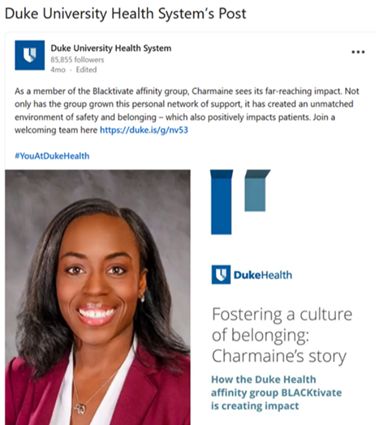
Enterprise intranet, newsletter, leadership announcements, social media storytelling (LinkedIn)
Internal Communications
Use of the organization’s intranet, newsletters, Microsoft Teams, and email channels to promote activities and share success stories.
External Communications Example:
- LinkedIn post:
Internal Communications Example:
- The link below is an example of an affinity group executive sponsor video. This video has been featured in hospital newsletters, highlighted on our organization’s intranet homepage, and now resides in a dedicated space on the affinity group site for ongoing visibility and engagement.
- Duke Moms executive sponsor video: https://vimeo.com/1127997016/e6f3d9805e?share=copy&fl=sv&fe=ci
Stakeholder Engagement Plan
Internal Stakeholders
- Senior leaders engage by integrating group insights into decision-making. Regular sharing of impactful data and stories maintains leadership support.
- Executive Sponsor for each Affinity Group.
Key Champions
Employee Experience, People Analytics & Innovation, Marketing & Communications, Senior Leadership, Frontline Management, IT, Culture & Belonging Committee, HR Onboarding, University and School of Medicine Partners, Legal Counsel, Procurement.
- Employee Experience (Culture and Belonging, Well-being, Employee Listening, Change Management, Talent Development)
- People Analytics and Innovation – Data tracking and impact analysis
- Marketing & Communications – Promotion, branding, and storytelling
- Senior Leadership – Strategic alignment and visibility
- Frontline Management – Day-to-day support and advocacy
- IT – Platform/technical support and data integration
- Culture and Belonging Committees – Alignment and support
- HR Onboarding- Introduce new employees to our groups
- University and School of Medicine Partners – Broader engagement and collaboration
- Legal Counsel – Risk mitigation and compliance guidance
- Procurement- approved vendors, various finance components
Marketing and Promotion
- Branding: Development of logos and specific messaging for launch announcements.
- Visibility: Dedicated space in organizational-wide newsletters and an intranet calendar for activities.
- Multichannel Promotion: Social media, leadership announcements.
- Engagement Events: Lunch & learns, roadshows, onboarding events.
Target Participants
All Duke University Health System employees, including clinical, administrative, and support staff across all entities. The focus is on developing emerging leaders and cultivating an inclusive community.
Scalability and Transferability
The solution can be scaled by leveraging pilot learnings to refine processes. Virtual engagement platforms are recommended to connect members across different locations. For larger scales, assigned dedicated FTEs are critical for managing operations.
Evidence and Outcomes
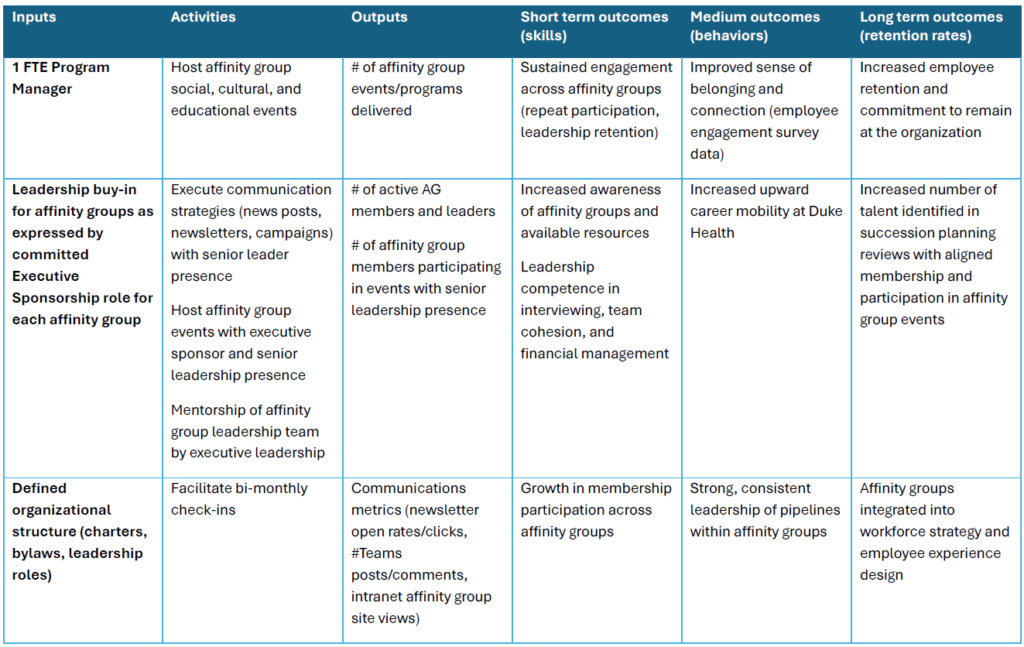
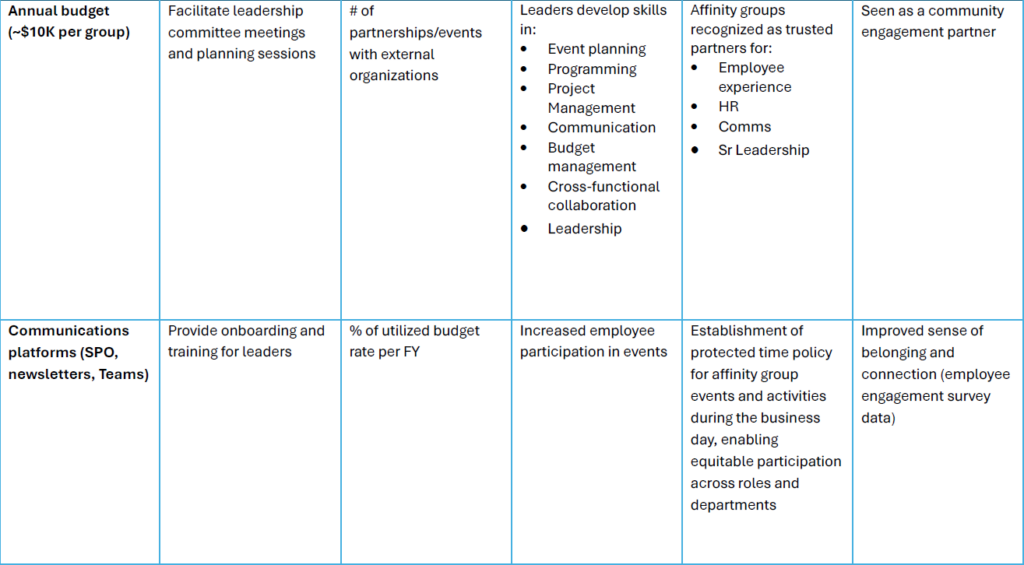
Logic Model
Project Goals
- Advance a culture of belonging.
- Improve employee engagement and retention.
- Support leadership competencies and talent development.
Indicators of Success
- Quantitative: Membership growth, event attendance rates, and year-over-year retention rates.
- Qualitative: Member feedback through surveys/forums and leadership testimonials.
- Benchmarking: Comparing engagement scores between participants and non-participants.
Data or Outcomes Demonstrating Effectiveness and Impact
- Preliminary analysis of employee engagement surveys for approximately 4,700 members. Success is identified through improved belonging scores and lower turnover rates calculated from HRIS data.
- Link to Evaluation Plan (attached separately)
Governance and Oversight
- Strategic Oversight: Provided by Executive Sponsors and Senior Leadership.
- Operational Management: Managed by a Point of Contact/Program Manager and supported by HR/Centers of Excellence.
- Group-Level Governance: Each group maintains its own leadership roles (co-chairs) and steering committees.
Business Case/Budget
Summary of associated costs for the resources (financial, human/staff, technological, etc.) needed to implement the solution.
Program Budget
- Developmental/Implementation: Costs include branding, launch announcements, and standardized resource creation.
- Resource allotment: $10,000 per group, per year
- Sustainment: non- dedicated budget for affinity group leader/employee experience programming (end of year celebration, staff training expenses, and communications) that is outside of designated group budget but is low/no cost or absorbed by employee experience budget. Up to $5,000 outside of affinity group dedicated budget.
- Staffing: Can range from collective support (low-fidelity) to a dedicated paid position (high-fidelity).
- Program Manager: $63,500-$127,000 per year salary (1 FTE)
Program Benefits
- Retention: Reducing turnover by creating a more inclusive workplace.
- Innovation: Surfacing critical insights about employee experience to drive workforce innovation.
Financial Impact (Return on Investment)
- The program serves as a strategic asset for competitive advantage. The focus is on cost avoidance related to improved retention and reduced turnover.
- 4% increased likelihood to stay over the next two-years implies a potential 188 averted departures from the Health System, which conservatively equates to $50,000 per departure; equaling a cost of avoidance of $9.4M over the next two years.
Other Considerations for Sustaining the Solution
Sustainment is secured through succession planning tools, ongoing professional development for leaders, and regularly reviewing group relevance to adapt to internal/external changes.