
Tri‑Share Childcare Program
Tri‑Share Childcare Program
Childcare access remains a critical but often overlooked workforce barrier in healthcare employment, particularly for frontline workers who frequently work nontraditional hours, rotating shifts, and extended schedules. In North Carolina, inadequate access to affordable, reliable childcare contributes directly to workforce absenteeism, turnover, and reduced labor force participation, creating significant strain on employers and healthcare systems. A 2024 analysis by the NC Chamber Foundation, U.S. Chamber of Commerce Foundation, and NC Child found that childcare-related disruptions cost North Carolina’s economy $5.65 billion annually, including $4.29 billion in employer losses tied to absenteeism and turnover (Smith, 2024). These disruptions are especially consequential in healthcare, where staffing shortages already impact patient care quality, workforce retention, and organizational stability. For healthcare employers, addressing childcare access is not simply a family-support strategy; it is increasingly a workforce retention and economic resilience strategy.
What Is Tri‑Share?
Tri-Share is a statewide childcare cost-sharing program administered by the North Carolina Partnership for Children in collaboration with three Regional Hubs. The program splits the cost of childcare evenly among three parties:
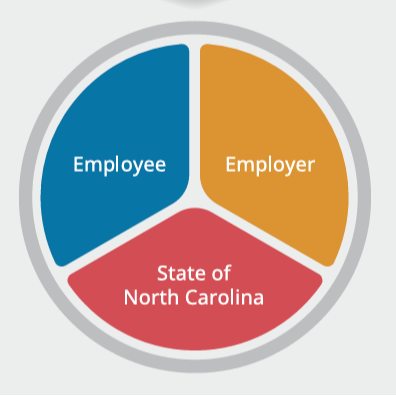
- 1/3 paid by the employee
- 1/3 paid by the employer
- 1/3 paid by the State of North Carolina
The program is designed as a workforce stability resource that helps employees consistently show up for work by making childcare more affordable and reliable. It is particularly valuable for working families who may earn too much to qualify for traditional childcare assistance but still struggle with the rising cost of care. The program supports employers across North Carolina, including healthcare organizations, long-term care providers, and other frontline industries.
How the Program Works (At a High Level)
- Employer enrolls in Tri-Share and agrees to contribute one-third of participating employees’ childcare costs.
- Employees apply through a Regional Hub, which manages:
- Employee eligibility review
- Childcare provider verification
- Enrollment support and administration
- Licensed childcare providers enroll at no cost.
- Monthly childcare payments are divided among the employee, employer, and state.
Importantly:
- Employers do not determine employee eligibility.
- Employers do not need to coordinate directly with childcare providers.
- Childcare providers can vary by employee, as long as they are licensed and in good standing.
- Regional Hubs provide administrative support to help employers navigate enrollment, participation, and payment processes.
Tri‑Share is helpful for healthcare employers in the following ways:
Childcare breakdowns are a major driver of:
- Call‑outs
- Missed shifts
- Last‑minute scheduling disruptions
Tri‑Share reduces instability by making childcare financially sustainable, improving day‑to‑day reliability for healthcare operations, especially in 24/7 environments like long‑term care and hospitals.
NC Healthcare employers experience extremely high turnover amongst their staff. Employees may leave for relatively small wage increases (sometimes as little as $0.25–$0.50 per hour).
Changes in pay can also influence employee eligibility for subsidized childcare that may be available as well.
Tri‑Share provides something more durable than a small wage increase:
- A meaningful reduction in monthly household expenses
- A benefit employees do not want to lose by switching employers
Cost-Benefit Example:
- Childcare cost: $1,000/month
- Employee pays ~$333 instead of $1,000
- $8,000 annual household relief.
Replacing an employee is expensive. For CNAs earning ~$30,000/year:
- Replacement cost: ~$9,000–$15,000
- Includes recruitment, onboarding, overtime coverage, and lost productivity.
By contrast:
- Employer Tri‑Share cost ≈ $4,000 per employee per year*
- Often results in retention, improved morale, and referral-based hiring
*Applicable administrative fees may also apply
Tri‑Share is frequently more cost‑effective than across‑the‑board wage increases, which permanently raise payroll and payroll tax obligations
Employers can choose:
- To begin with a limited number of eligible employees
- Whether to expand participation over time
Many organizations begin with a small pilot group of eligible employees to assess impact and budget considerations before scaling the benefit more broadly. Because there is no minimum business size requirement, Tri-Share can be an approachable workforce investment for organizations of varying sizes.
How To Enroll as an Employer
Employers interested in Tri-Share do not need to develop a childcare benefit program from scratch. North Carolina’s Tri-Share program is supported by three Regional Hubs that work directly with employers, employees, and childcare providers throughout the enrollment process.
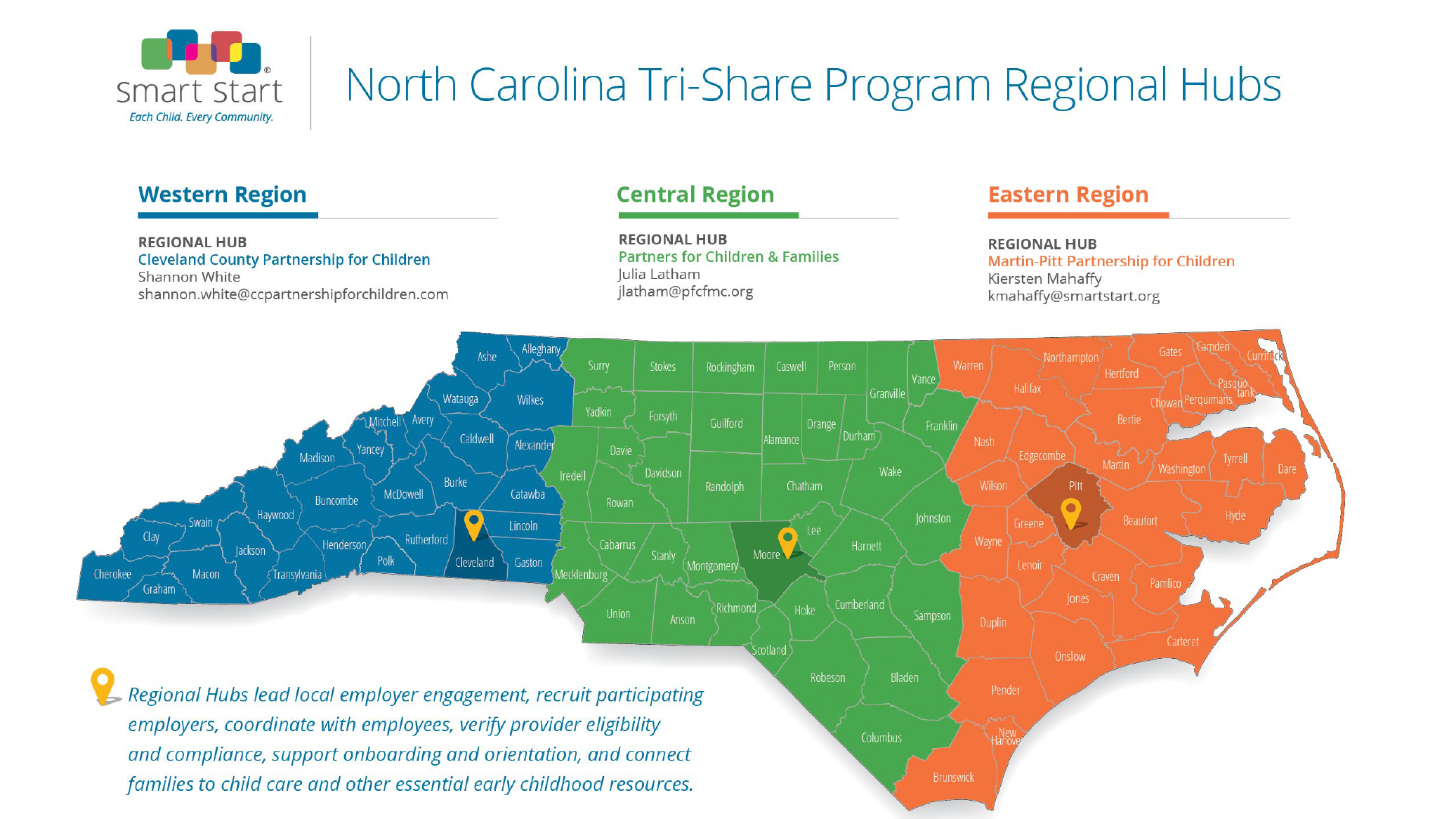
Regional Hubs can help employers:
- Understand program requirements
- Estimate participation costs
- Identify employees who may be eligible for the program for Tri-Share eligibility review and determination
- Coordinate enrollment
- Manage ongoing administration and payment processes
Healthcare organizations can begin with a small group of participating employees and expand over time as they evaluate outcomes related to retention, attendance, and workforce stability. Employers interested in exploring the program can connect with their Regional Hub through the NC Tri-Share program website and enrollment resources.
Barriers in Healthcare That Tri‑Share Helps Solve
Many healthcare employees fall into a challenging gap: they may not qualify for traditional childcare assistance programs, yet the cost of childcare still places significant strain on household finances.
Tri-Share helps bridge that gap by reducing childcare costs through a shared-investment model that makes reliable care more attainable for working families. By lowering one of the most significant household expenses, employers can improve workforce stability while helping employees remain engaged in the workforce.
In rural areas:
- Childcare options are limited
- Losing one worker can severely disrupt operations
- Replacements are harder to find
Tri‑Share supports:
- Home‑based and small licensed providers
- Employees who rely on trusted, local childcare relationships
- Economic stability within rural communities.
Traditional benefits packages often fail to address:
- Shift‑based schedules
- Single parents
- Non‑traditional work hours
Tri‑Share directly addresses one of the primary reasons frontline workers leave healthcare jobs-inconsistent or unaffordable childcare- without requiring employers to overhaul their entire benefits structure.
Key Takeaways for Healthcare Employers
- Tri-Share is a statewide North Carolina program administered by the North Carolina Partnership for Children in collaboration with Regional Hubs.
- It addresses retention, attendance, and workforce stability.
- It is particularly valuable for healthcare and frontline employers facing staffing challenges.
- It supports working families who struggle with childcare costs but may not qualify for traditional childcare assistance.
- Employers can start with a small group of employees and expand participation over time.
- Regional Hubs provide guidance and administrative support to simplify implementation.
Tri‑Share is a strategic workforce resource that aligns employer ROI with employee stability and well‑being.
Sources:
Smith, M. (2024). The hidden cost of child care gaps in North Carolina’s economy. NC Department of Commerce, Labor & Economic Analysis Division.