
2026 Data Submission
Overview
The NC Center on the Workforce for Health is launching the 2026 employer demand workforce survey for the NC Health Talent Alliance, a partnership between the Center, the NC Chamber Foundation, and NC Area Health Education Centers (NC AHEC), and coordinated with many statewide associations and organizations.
The last two data collection efforts were successful thanks to your support!
The analyzed data is being used to drive state and regional action, policy,
investments, and solutions in critical workforce pipelines.
As in the previous two years, this year’s survey focuses on employer demand data for RNs, LPNs, CNAs, and MAs, while expanding into new professions. New positions include paramedics/EMTs, radiology technicians, community health workers, mental health counselors, and social workers.
How to Submit Data
We will collect employer workforce demand data through two channels:
Qualtrics Upload (all employers)
Similar to prior years, employers will submit data using a submission template (Excel) that is uploaded and submitted through Qualtrics.
The submission template is available for download in the Qualtrics survey.
Radius Group (by invitation)
In 2025, we partnered with a workforce analytics firm, Radius Group, to pilot a data submission method with five health systems. This approach was highly successful and yielded high quality, robust data with less heavy lifting among the participating health systems. This year we plan to expand that method to 30 organizations based on size of workforce and number of facilities.
If you would like to learn more, contact us at htadata@ncahec.net.
What Data Is Requested
The first two years of HTA data collection focused on four positions (RNs, LPNs, CNAs, and medical assistants) based on prior research on workforce needs across a broad array of healthcare settings. The analysis has proven valuable to drive regional and state planning and action to bolster talent pipelines and stabilize the workforce.
This year, we will expand the analysis beyond the four positions that we prioritized in 2024 and 2025 while remaining consistent to the metrics we track across positions.
Professions/Positions
The 2026 cycle includes an expanded set of priority occupations to reflect input from stakeholders and analysis of current workforce pressures, including:
- Registered Nurses (RNs)
- Licensed Practical Nurses (LPNs)
- Certified Nursing Assistants (CNAs)
- Medical Assistants (MAs)
- Paramedics
- Emergency Management Technicians (EMTs)
- Radiology Technologists
- Social Workers (BSW)
- Social Workers (MSW)
- Mental Health Counselors
- Community Health Workers
Key Workforce Metrics
Permanent Positions (Employees that receive a W-2)
- Count of open and ready to fill positions January 2026
- Headcount on December 31, 2025
- All hires in 2025
- All separations/exits in 2025
Contingent Positions (Non-W-2 positions)
- Count of open and ready to fill positions January 2026
- Headcount on December 31, 2025
- All hires in 2025
- All separations/exits in 2025
How the Data Supports Health Workforce
The Health Talent Alliance was launched in partnership with the NC Chamber Foundation and NC AHEC to get clear about regional health workforce challenges, prioritize interventions, and drive action to strengthen and stabilize the health workforce. The annual data collection is essential to understand employer needs at a level of granularity that existing data sources cannot provide.
We use HTA data analysis to:
- Inform Policy, Funding, and Program Decisions
- Support state agencies, funders, and partners in targeting investments
- Enable clearer alignment between workforce demand and training supply
- Provide transparent, documented methods for public reporting
- Drive Regional HTA Planning
- Provide regional collaboratives with evidence to prioritize interventions
- Inform employer–educator discussions with shared, neutral data
- Reduce reliance on anecdotal or fragmented information
- Identify Where Demand Pressure Is Greatest
- Track vacancy, churn, and hiring patterns by profession and region
- Distinguish pipeline challenges from retention challenges
- Improve Coordination Across Workforce Initiatives
- Create a common data foundation amid increasing external funding and initiatives
- Help regions avoid duplicative efforts and employer fatigue
- Clarify how local efforts fit within statewide workforce strategy
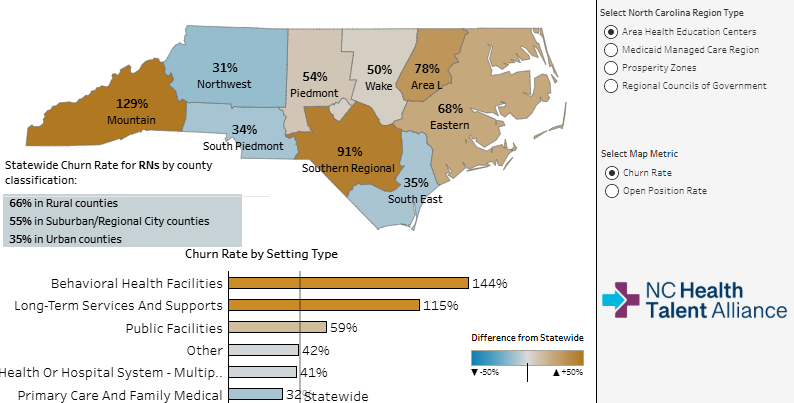
To see the full 2025 HTA Data Analysis, visit the link below.
Thank You!!
Your contributions through data and engagement is essential as we continue the shared work of strengthening North Carolina’s health workforce. We deeply appreciate your participation.
If you have any questions or suggestions, please contact us at htadata@ncahec.net.