
Student-Employer Engagement
What is student-employer engagement?
Student-employer engagement refers to the active involvement of students in activities that connect their educational experiences with real-world applications—specifically, in this context, connecting students early with employers in their field of study. It includes integrating employers into the academic calendar or curriculum, organizing job-related events, and providing students with a clear understanding of employment and onboarding processes.
Why is student-employer engagement important?
Student-employer engagement is important because it helps address major challenges such as students delaying licensure, leaving the healthcare field, or relocating out of the region. Engaging students early with employers increases their awareness of local job opportunities, clarifies the job application and onboarding processes, and builds confidence in transitioning from education to employment. It also helps reduce uncertainty and financial hesitation related to licensure and job prospects.

The strategies and activities listed below are grouped into three categories, helping students to:
- Understand the region’s employment options.
- Prepare to seek a job.
- Secure a job
Methods
To inform the development of a reimagined model for employer engagement and talent pipeline management in the healthcare sector, the NC HTA team, in collaboration with project partners, conducted a multi-source review of best practices and emerging strategies. This process included direct engagement with subject matter experts from community colleges, four-year institutions, healthcare employers, and nonprofit organizations. These perspectives were invaluable in shaping a more integrated, responsive, and equity-informed approach.
A key model reviewed was developed by UNC University Career Services (UCS). Their External Relations Team provides a structured framework for employer engagement across four main pathways: on-campus recruitment, student career development, campus community partnerships, and the Carolina Career Sponsors and Partners Programs. The UCS model also highlights several experiential engagement practices, including co-hosted workshops, career fairs, and a Career & Industry Pathways website. Of particular interest was the Micro-Internship Program, which partners with select employers to provide short-term, paid professional projects. The program’s prioritization of underrepresented student populations offers a replicable model for inclusive talent development.
Additional insights were drawn from the National Healthcareer Association (NHA), particularly their Open Pathways to Increased Student Engagement initiative. The associated e-book explores three core strategies for modern healthcare education: digital learning platforms, immersive learning experiences, and virtual, scenario-based environments. This resource provided practical implementation examples and evidence-based strategies for enhancing student engagement in healthcare training.
The research process also incorporated the Pennsylvania State System of Higher Education (PASSHE) Employer Engagement Action Plan, which outlines a system-level approach to workforce alignment through stronger employer partnerships. This action plan offered a strategic framework for institutionalizing employer input in curriculum development, internship expansion, and program design. These principles directly informed our design.
Finally, our team consulted the Greater Raleigh Chamber of Commerce’s Employer Engagement and Recruitment Groupresources, which provided insight into regionally relevant employer engagement strategies. This included best practices in healthcare recruitment, existing public-private partnerships, and examples of cross-sector collaboration that are critical for scaling workforce solutions.
Together, these resources supported a comprehensive understanding of existing employer engagement models and helped shape a revised design that is adaptive, inclusive, and better aligned with evolving workforce needs in healthcare. As you engage with our toolkit, we request your feedback on what elements of the toolkit works well and where improvements could potentially be made. We encourage you to share your experiences with us as we continue to create additional iterations of this toolkit with your feedback in mind.
Who are these strategies for?
These strategies can be used by any employer or educator interested in fostering better connections between students and employers.

Strategy 1: Ensure Students Understand the Region’s Employment Options
Nursing students have a lot on their plates in terms of preparing for their education. While they are thinking about their classes and projects, it is also important to learn about the employment options that they can consider within their region. Potential activities include:
A. Panel Discussion with Former Students
Four or five former students who currently work in different types of settings can have a facilitated discussion about potential career paths. The goals for this activity include raising awareness of local opportunities and building confidence in students’ abilities. It can be very powerful for current students to hear from recent graduates about how they are moving up in their careers.
B. Presentations from Employers
Provide 10 minutes to a range of employers to talk about the types of opportunities they offer, the expectations for entry-level employees, and the potential career paths for new hires. Employers can also talk about specific incentives they offer for new hires, as appropriate. The goal of this activity is to help students understand there are potentially a wide range of factors in determining the types of jobs that are the right fit for them.
Strategy 2: Prepare Students for Job Seeking
In the first set of activities, students received information about the various employment opportunities in the region. With that knowledge, students should learn about how to put their best foot forward and prepare for the job search process. Education institutions and TPM collaboratives can consider how to facilitate direct interaction between employers and faculty to bring these activities to the students, aligned with curriculum.
A. Employer Walkthrough of the Application Process
Employers can walk students through the job application process. They can explain how certain activities and terms on the job descriptions match with the actual skills the students are acquiring. A potential best practice for employers is to establish a firm timeline for response to every nursing position application. Ideally, each applicant is responded to within a week and will receive a timeline for decision-making.
B. Resume and Interview Preparation
Employers can volunteer time to work with students on mock interviews or other activities that introduce them to the interview process. This could be done individually or as part of small group exercises. Both education institutions and employer volunteers might also assist students with resume preparation or review. For some institutions, the mock interview process is built into the curriculum.
C. On-site and/or Virtual Facility Tours
Employers can work with the education institution to create schedules and provide transportation for groups of students. Employers can also consider creating a virtual facility tour. When students make these kinds of direct connections to employers, they are more likely to follow through on job applications.
Strategy 3: Help Students Get Jobs
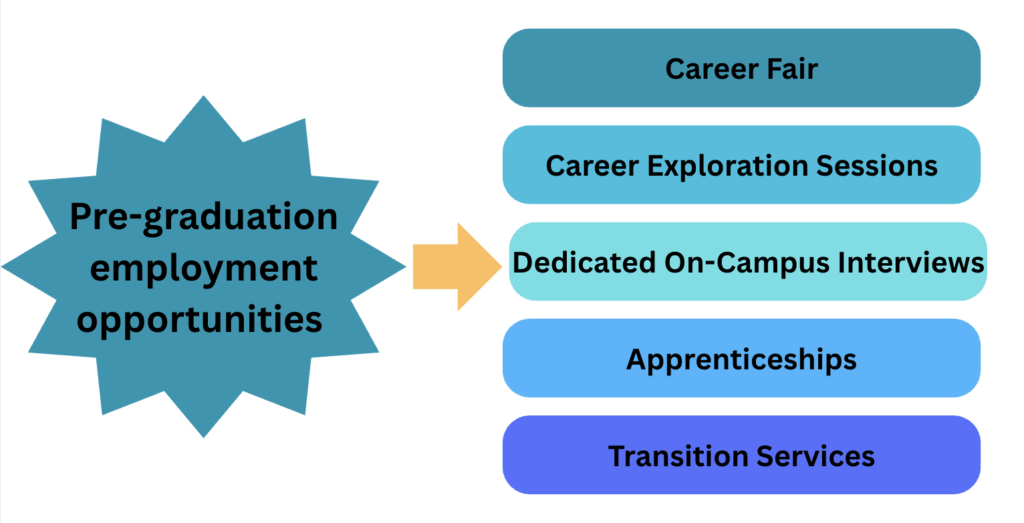
Now that students have a clear picture of the region’s employers and the job application process, the goal is for employers to offer as many pre-graduation job commitments as possible. Many different activities can bring students into direct contact with decision-makers for local employers. Coordinated activities ideally help bring a range of employers to the table in order to provide students with options that match their goals.
A. Career Fair
The career fair should be set up to accommodate as many local health care employers as possible. Rather than an event in which students fill a bag with brochures, career fairs can be the culmination of all previous efforts, where prepared students can match with engaged employers.
B. Career Exploration Sessions
Short sessions (30-50 minutes) can be grouped together as part of an event or incorporated into the academic calendar. The purpose of these sessions is to give students better knowledge of the range of careers available and the potential paths for entering those careers.
C. Dedicated On-Campus Interviews
Employers can sign up for dedicated time and space on the campus to conduct interviews. Priority can be given to students who participated in previous activities and provided feedback via surveys.
D. Apprenticeships
Employers and educational institutions can work together to expand the number of students entering apprenticeships.
E. Transition Services
There are many potential small, but meaningful, barriers to students making the transition into the workforce. The expense of test preparation, purchase of scrubs, transportation, and paperwork preparation are all barriers that can be removed through effective collaboration.
Surveying Students on their Career Exploration
The goal of the toolkit is to create better outcomes for both students and employers. Specifically, the activities in the toolkit are meant to increase the number of nursing program The Student-Employer Engagement Toolkit outlines a variety of student-centered activities designed to enhance interactions between employers and students. Given the diversity of approaches that employers may take in their presentations and one-on-one engagements, the Health Talent Alliance strongly recommends the use of student surveys to evaluate the effectiveness of these business engagement activities.
These surveys should be administered anonymously to ensure honest feedback and should aim to assess whether the activities are achieving the following outcomes:
- Increasing student awareness of local employers
- Enhancing students’ understanding of the job search and application process
- Improving students’ success in securing employment
Anonymous feedback can be collected in multiple ways. One approach is to administer surveys immediately following each event. Alternatively, a comprehensive survey can be conducted toward the end of students’ academic programs to capture their overall experience with employer engagement.
The insights gathered from these surveys should be used to inform and continuously refine the programming recommended in the Student Engagement Toolkit, ensuring it remains effective and relevant to student needs.
What’s Next?
To get started, convene a group of employers and educators who will work together to conduct these activities. Before you meet, have all participants read this Student-Employer Engagement guide. Then use your initial “launch meeting” to explore what issues you’re actually seeing on the ground and consider which activities might be most helpful for you.